

In my pre-IPO piece two weeks ago, I looked through the S-1 and argued that $1.4T–$1.5T was not a crazy price for what could become one of the largest profit pools in tech.
I want to update my thesis here, because a couple of my own views from earlier this year have shifted meaningfully. For most of 2025 and 2026, I believed two things: first, that there is no real moat in AI models; and second, that most of knowledge work will not need the best frontier model and will default to cheap, “good enough” open-weight alternatives.
Recent changes in the environment and my thinking have made me amend some of those views, which also led me to open a position in Anthropic. When you put together the distillation crackdown, Anthropic’s ~$250B post-IPO cash balance, the economics of internal distillation, and the actual math behind its compute commitments, the setup looks much stronger than the market is giving it credit for.
In this article, I cover:
Why the distillation crackdown is the key thing for Anthropic
The $250B war chest and why Anthropic’s valuation traps OpenAI
Internal distillation and why a 0.2% edge compounds in knowledge work
The real moat is scale (and what RSI training runs will cost)
Verticalization, and why cyber is the next big one
Anthropic’s compute commitment worries
Valuation of Anthropic
Let’s dive in.
The distillation crackdown is working—and the gap is widening
In October, I wrote that only a few index points separated the best closed models from the best models you could download for free. That was true on public benchmarks, largely because open-weight labs had an extraordinarily cheap shortcut: distillation.
If you are unfamiliar with the term, distillation is when you train a smaller or cheaper model (the student) on the outputs of a bigger, smarter model (the teacher). Think of a student who never reads the textbook, but gets millions of worked-out solutions from the smartest kid in the class. He will never beat the top student, but he can get 95% of the way there for a fraction of the compute cost.
Every lab distills its own models internally—that is how Anthropic builds Claude Haiku. The problem was external labs doing it to Claude at industrial scale through fraudulent accounts. In its 154-page September 10 threat report, Anthropic disclosed that seven China-based labs (including operators linked to Alibaba, Moonshot, DeepSeek, Zhipu, and MiniMax) ran roughly 190 million exchanges against Claude to extract its capabilities. The Alibaba-linked campaign alone generated 151 million exchanges across more than 3,500 fake accounts, peaking at nearly 3 million queries a day. That was more than a 10x jump from the 16 million exchanges Anthropic flagged in February.
Since August and September, Anthropic shut the door. It added identity verification for high-risk regions, moved to organization-level bans within two hours of detecting a campaign, and hid more of the model’s internal chain-of-thought reasoning (which is the highest-signal training data for a student model). According to the S-1, Anthropic willingly gave up 5% to 7% of its first nine months of 2026 revenue—roughly $1.7B to $2.3B on $33.2B of sales—by cutting off customers that breached its usage terms. Anthropic published that the first results are that the amount of data harvested by distillers fell by around 90% to 99%.
We are now starting to see the first real-world evidence that the crackdown is biting:
Artificial Analysis Intelligence Index v5: When Artificial Analysis rebuilt its index on October 27 so that 60% of the score comes from private, held-out test sets, the gap between frontier and open-weight jumped from 3 points to 12 points (Claude Opus 5.5 at 58 vs. Kimi K3.1 Pro at 46). Against open models you can actually download, the gap widened to 26 points (DeepSeek V4.1 Flash and GLM-5.3 at 32, sitting below Anthropic’s smallest model, Claude Haiku 5.5, at 36). With Claude Fable 5.2 (scoring 65), the gap is 19 points.
36Kr’s Intelligent Emergence interviewed researchers and investors inside the Chinese AI industry and found some interesting answers. A senior researcher at a major Chinese AI company told 36Kr that “obtaining useful training data through model distillation can now take ten attempts where one previously sufficed”. An AI data industry insider went further, arguing that anti-distillation measures could hurt Chinese labs more than U.S. chip export restrictions. Another researcher who previously had access to over 1,000 GPUs at his peak noted that even 10x that capacity (10,000+ GPUs) might not be enough for large-scale experiments now. Zhipu’s founder Tang Jie is quoted as saying the gap »is actually widening«.
No standard benchmarks for GLM-5.4: On November 23, Z.ai released GLM-5.4 (a 750B-parameter model built on a looped transformer architecture), which reporting suggests was shipped as a stopgap as new November 19 U.S. licensing rules on overseas data centers push GLM-5.5 into 2027. Notably, Z.ai published no standard benchmark table—no MMLU, no SWE-bench, and no Artificial Analysis score. On community-run KingBench 4, GLM-5.4 scored 33.2 versus Claude Fable 5.2’s 42.0, and it took 431 minutes and ~1.04 million reasoning tokens across 1,128 turns to get there.
Even the cloud providers who benefit from open-weight adoption are admitting it. On Alex Heath’s Sources podcast in November, AWS CEO Matt Garman said it is an open secret that distillation has been a major driver of open-source lab development, and that the crackdown could widen the gap between frontier labs and open models going forward. AWS hosts roughly two dozen open-weight models on Bedrock and makes money when customers run them.
The $250B war chest—and why Anthropic’s stock price boxes in OpenAI
Anthropic did not just go public to give employees liquidity. It went public to lock up a fortress balance sheet before the next phase of the compute arms race begins.
Look at the cash math post-IPO:
Pre-IPO cash & short-term investments (Sept 30, 2026): $131.8B ($95.6B cash and $36.3B short-term investments, per the S-1/A).
Primary IPO proceeds: 956.35M primary shares sold by Anthropic at $83 = $79.4B gross (~$78B net).
Simultaneous private placement: $26B from Google, Nvidia, AMD, and other strategic suppliers.
Greenshoe option & operating cash flow: Up to $12.2B from the 147M-share underwriter overallotment option, plus positive operating cash flow (+$6.6B in the first nine months of 2026) and $14.8B in unused credit facilities.
Add it up, and Anthropic is sitting on roughly $250B+ of cash on its balance sheet.
This does two things. First, it means Anthropic can self-finance the next several generations of training loops without begging private markets for capital—even if we hit Recursive Self-Improvement (RSI), where the primary driver of the next frontier model is simply how much compute you can throw at automated research and reinforcement learning, and even if market conditions for AI becomes bad.
Second, and this is underappreciated by the market, Anthropic’s public valuation now acts as a hard ceiling on OpenAI’s fundraising.
On November 6, OpenAI closed the first $11B tranche of a new private round at a $1.25T post-money valuation—cutting its target down from an initial $30B+ ask at $1.4T after public AI stocks sold off in October. Now compare the two businesses side by side:
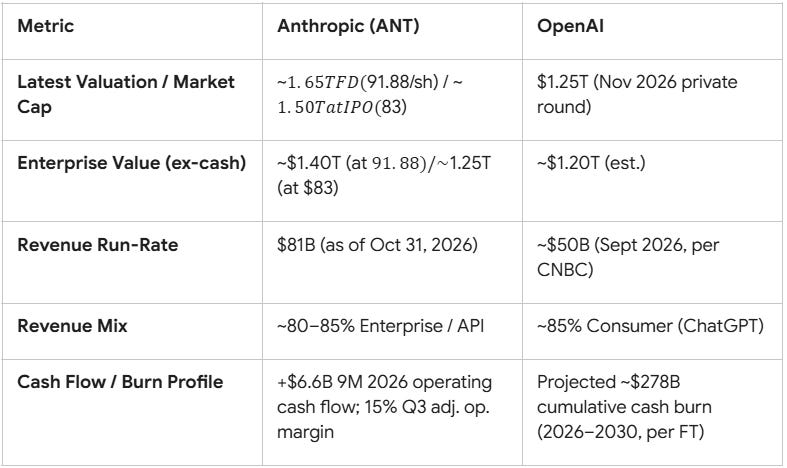
Think about what happens when OpenAI goes back to institutional investors for its next mega-round or tries to revive its delayed IPO. Right now, any public equity manager can buy Anthropic—a company with a 62% higher revenue run-rate, a much stickier enterprise mix, positive operating cash flow, and $250B in cash—at an EV of $1.25T to $1.40T.
As long as Anthropic trades anywhere near these levels (83–92), OpenAI is in a bind. It has worse unit economics, slower revenue momentum, and a projected $278B multi-year cash burn. Raising another 30B–50B or listing publicly above $1.25T becomes very difficult without taking a down round. Anthropic did not just raise $100B+; by pricing into a nervous market and letting the stock settle at a reasonable multiple, it effectively choked off its primary private rival’s cost of capital. The timing also seems key, as we are about to enter the RSI training era where compute is the only factor that determines the speed of the AI model development (ex significant regulatory changes)
Internal distillation and why a 0.2% edge wins knowledge work
In the past, I argued that knowledge work—customer support, accounting, compliance, basic legal review, back-office operations—would not need frontier intelligence, and that cheap open-weight models would capture most of that volume.
Here is why I changed my mind: when you shut down external distillation, you do not just protect the top of the price ladder. You protect the bottom of it too.
Anthropic has full access to its own frontier teacher model, including all the hidden reasoning traces that outside labs can no longer scrape. That allows Anthropic to distill its frontier model into smaller, drastically cheaper student models that still outperform open-weight alternatives. We already saw proof of this in the S-1: Opus 5.5 cut customer costs per task by ~40% compared to Opus 5, while remaining completely margin-neutral (Anthropic’s inference gross margin was 85% across the first nine months of 2026).
If the gap between Anthropic’s frontier teacher and open-weight models widens because external distillation is broken, Anthropic can offer its own distilled small models at the exact same price as open-weight providers—but with better intelligence.
Now think about how a CFO or COO buys AI for knowledge work. Nobody is going to pay 10x more for a frontier model to answer tier-1 customer support tickets or reconcile invoices. Base intelligence is table stakes. You want better AI workers for the same reason you want better human workers—not at any price, of course, but if Model A is even 0.2% better than Model B at the same cost, you take Model A every single time.
And in an enterprise deploying thousands of autonomous AI agents, 0.2% does not stay 0.2%. It compounds:
If an organization runs 5,000 AI agents handling 10 million multi-step workflows a year, a 0.2% reduction in error rate or escalation rate eliminates 20,000 failed tasks, downstream human interventions, and compliance mistakes.
Because agents chain tasks together (say, 20 steps in a single workflow), a 0.2% per-step accuracy advantage (0.99220 vs. 0.99020) compounds into a ~3.4% higher end-to-end completion rate across the workflow.
Multiplied across thousands of AI workers running 24/7, a tiny intelligence advantage at price parity turns into a structurally more efficient company. Customers trading down on price do not need to leave Anthropic to go to DeepSeek or GLM—they just trade down inside Anthropic’s own distilled model tiers.
This is a key concept that would essentially monopolize the market into the company that owns the frontier and is able to finance the compute.
The moat is scale—and what RSI training runs will cost
I used to believe there was no lasting moat in AI models because every few months someone else caught up on the leaderboard. Now I believe the moat is scale: specifically, the capital required to train the next frontier teacher model from which you distill every cheaper model you sell.
Look at how fast the cost of staying on the frontier is escalating. Looking at Anthropic’s S-1, total compute spending has been growing 4x per year, rising from $433M in 2023 to $7.3B in 2025 to $18.8B in the first nine months of 2026 ($9.9B in Q3 alone, or a ~$40B annualized run-rate). Its R&D spending—which is where training and research compute sits—jumped from $2.3B in 2024 to $6.3B in 2025 to $19.2B in the first nine months of 2026 ($9.5B in Q3 alone).
That is before Recursive Self-Improvement (RSI) fully kicks in. Anthropic’s Alignment Science Lead Evan Hubinger has said the self-improvement loop is “happening faster than we thought,” and an October 2026 Gladstone AI survey of frontier researchers found most expect early RSI to begin within 3 to 12 months.
When you enter an RSI regime, AI models design experiments, generate synthetic training data, write kernels (Claude already ported Mythos to AMD GPUs in three days), and run massive reinforcement learning loops autonomously. Human researcher headcount stops being the bottleneck. The only bottleneck is how much compute you can finance.
Let’s do some rough math on what that barrier to entry looks like:
2026: Anthropic is spending ~$25B+ annualized on R&D (mostly training/research compute), with individual frontier pre-training plus post-training/RL cycles costing an estimated 2B–5B.
2027–2028 (Early RSI): If compute intensity per generation scales another 3x–5x as automated RL and synthetic data loops run continuously, a single frontier generation will cost 10B–25B in compute alone.
2029–2030 (Full RSI): Annual R&D compute budgets for a top lab easily hit 50B–100B+, with flagship teacher model generations costing 30B–50B+.
Now ask yourself how many companies on Earth can write a 25B–50B check for a single model generation without knowing the exact ROI on day one?
Maybe three or four: Google ($265B cash, $200B/year capex), Meta (funded by its ad monopoly), and now Anthropic ($250B cash, $81B revenue run-rate, and positive operating cash flow). Startups, open-source collectives, and cash-burning rivals that can no longer distill Claude for free simply cannot clear that entry ticket. Scale is the moat.
There are questions about whether Meta and Google are even able to spend that much on training, not because they can’t, but because of other fundamental reasons. Meta is trying to catch up from behind, but their focus is on the consumer and personal agent, so ROI on frontier is much lower than what ROI is for someone like Anthropic, where the focus is enterprise. For Google, while they certainly have the cash and cash flow to continue with this, the question becomes allocating compute internally vs. externally and the tradeoff there. At some point, I believe they will have to decide whether they want to win the cloud infrastructure race or the AI model race, as funding both verticals in hopes of being the market leader will be too big an investment even for them. For Anthropic, there is no trade-off, so you know where all of their compute spend will go, on top of them still having a lead when it comes to frontier.
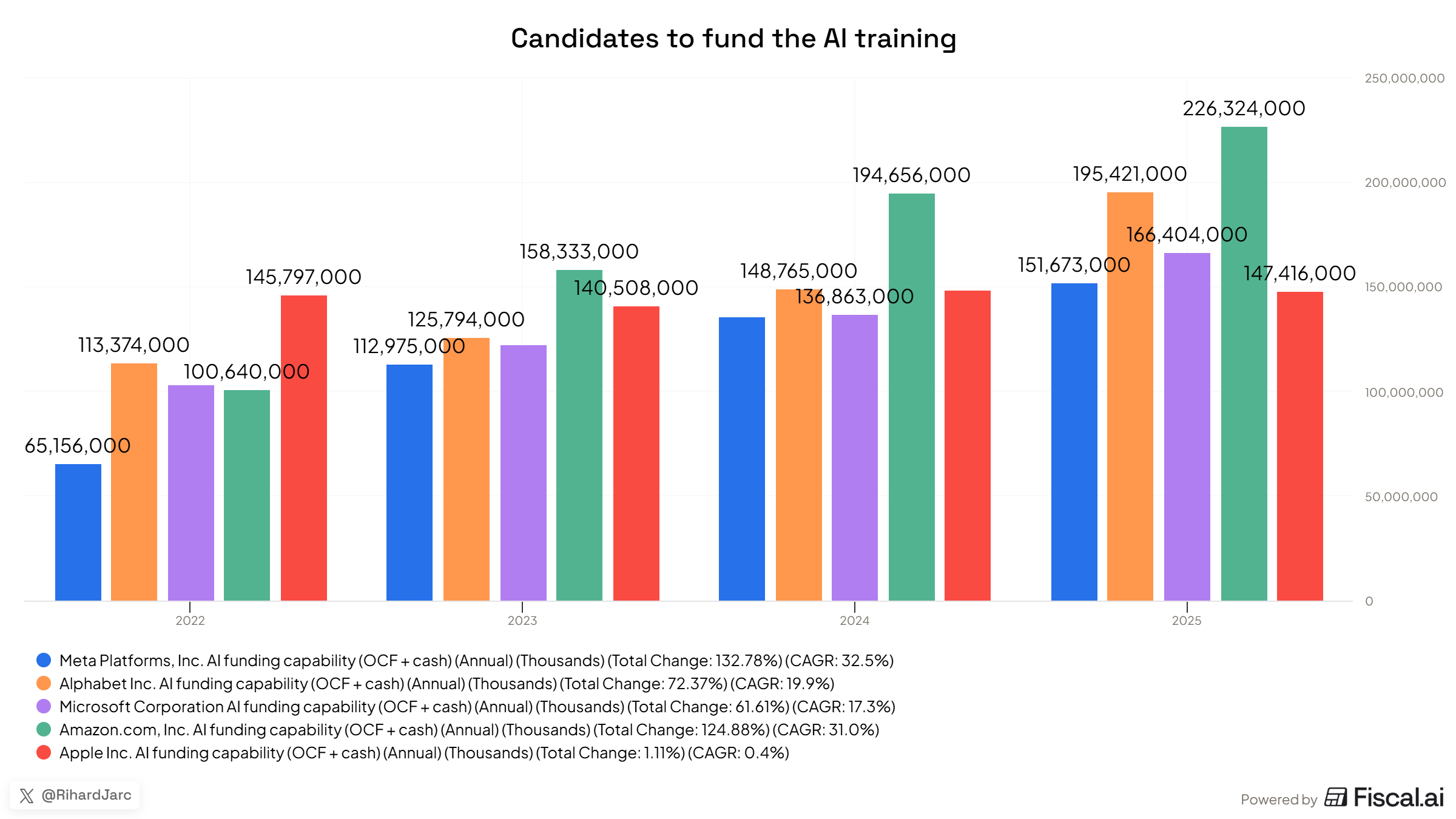
Based on pure financial numbers, the companies that could theoretically do it are also Amazon, Microsoft, and Apple (on top of Meta and Google already mentioned). But both Microsoft and Amazon are more focused on serving their cloud clients and serving their products, while Apple, with the current data center footprint and talent pool, is essentially already out of the race. I didn’t mention OpenAI, because for them to be in the race, they need a good and favorable market environment, and in that environment, Anthropic needs to trade higher at a higher valuation than it is today. The question also becomes if Anthropic’s valuation goes higher, how Anthropic’s management will look at it as an opportunity to raise additional funds, which again makes OpenAI’s story harder, as the amount of compute that the leader in AI models has determines the pace of development for the whole industry in an RSI world.
As long as scaling laws hold and each training run gets more expensive as it is a bigger and bigger model, the scale is the barrier to entry and forms the moat on top of the brand value, rather than adding to that.
Brand power, verticals, and why cybersecurity is a mandatory tax
A frontier model moat only turns into a great business if you capture the margin. Anthropic’s biggest strategic shift in 2026 is moving aggressively down the stack from a pure API provider into vertical products.
The numbers from the IPO roadshow show how fast this is working: more than 50% of Anthropic’s enterprise customers now use both its API platform and at least one of its own products, up from 30% in Q4 2025. Claude Code is the blueprint. By owning the application layer, Anthropic prices on the value of the outcome rather than raw tokens, routes subtasks internally to its cheapest distilled models, and cuts out cloud marketplace fees from AWS, Azure and GCP. In the first nine months of 2026, 44% of revenue went through AWS, GCP, and Azure marketplaces, and sales, marketing, and partner fees dropped from 22% of revenue in Q1 to 14% in Q3 (Anthropic’s own target is for those fees to be 7%–10% long-term target). The target itself shows that Anthropic will start to go deep into verticals on a product level.
And they are not stopping at coding. They are actively building out an enterprise sales machine to push products like Cowork, Claude Security, and vertical workflows directly into Fortune 500 accounts.
Looking ahead, every frontier lab needs the next big elastic vertical after coding. As I wrote in my pre-IPO piece, science has massive long-term potential (and the widest open-weight gap: 59–63% vs. 13% on Terminal-Bench-Science), but pharma monetization is bottlenecked by multi-year clinical trials and regulators. Energy and materials will monetize faster, but science is still a slower ramp.
Cybersecurity is the immediate mega-vertical—and it could end up even bigger than coding.
According to The Information this week, OpenAI CFO Sarah Friar said external estimates put the cybersecurity market above $300 billion far underestimate its true potential, and OpenAI President Greg Brockman stated there is “no question” cybersecurity will become a bigger business than coding.
Over the weeks of doing my research, I agree with him.
I not only believe it will be bigger, but I believe the adoption will be even faster than the coding one. Why? Because coding is an ROI decision, whereas cybersecurity is a mandatory tax:
You cannot opt out on Day 1: When Claude Mythos found thousands of high-severity vulnerabilities across every major OS and browser, the security baseline shifted overnight. Meanwhile, open-weight attacker models are already cheap and unstoppable—on Vals AI’s benchmark, DeepSeek V4.1 Flash completes 72.8% of attack objectives in simulated corporate networks for ~$3 per run.
Defense requires the frontier: An attacker only needs one hole. The defender has to find all of them first. No CISO, board, or cyber insurer will accept “we used a cheaper open-weight model to save 20%” after a breach. Every enterprise will have to pay frontier labs for an always-on defender model (like Claude Security) to continuously scan, validate, and patch systems against malicious AI models.
It compounds with AI code volume: Anthropic’s own engineers now ship more than 45x the daily code volume they did in 2024. More AI-written code means a vastly larger attack surface, and every time a new frontier model drops, companies have to re-scan their entire codebase to catch bugs the prior generation missed.
Even at conservative assumptions, if Anthropic’s 11,900+ customers spending over $100K/year add an average of $1M/year in automated security scanning and patching, that is ~$12B of high-margin recurring run-rate revenue—and large banks, defense contractors, and tech giants will spend multiples of that.
But the cyber tax will be paid not only by the 11.900 customers that spend +$100k a year, but by essentially every company in the world. The bigger and more complex the codebase, the more you will pay. Gone are the days when cyber was a subscription or fixed-price service; with AI it will be a variable-price one depending on the amount of scanning and patching that you need, and the incumbent cyber companies will serve it to customers via their networks, but a big portion of those revenues will go to the cyber frontier defender AI model provider that the cyber incumbents will have to pay that runs their service.
Cyber is the perfect use-case for frontier AI all the time. The margins will be high at those models (as you always need razor edge); the usage is unlimited (you must have a safe product/service at all times), and the faster AI models develop, the more scanning and patching your customers have to do to keep up with these models, so the revenue accelerates for the frontier lab.
The Anthropic fears: the +$900B compute commitments
One of the loudest concerns about Anthropic right now is its headline compute commitment, and what happens if growth slows in the future years: $895.4B in the amended S-1 (nudged up to ~$900.9B in the final pre-IPO filing). Critics look at ~$900B of obligations, compare it to $4.6B of 2025 revenue, and yell fire.
Let’s actually read the footnotes and do the math.
Cancellable vs. non-cancellable breakdown
Not all $895.4B is a rigid take-or-pay obligation:
Total disclosed compute & infrastructure commitments (S-1/A): ~$895.4B.
Subject to termination rights or contingent conditions: ~$213.8B (~24% of the total). The single largest piece here is the expensive SpaceXAI (formerly xAI) deal of up to $120.5B running through 2029. Crucially, SpaceXAI is only non-cancelable through January and March 2027—after that, either party can cancel with 90 days’ written notice. Another $17.4B is cancelable within one year or carries a term of one year or less.
True non-cancellable long-term commitments: ~$681.6B (~76% of the headline number).
Where does that ~$682B non-cancellable core sit? The major disclosed multi-year contracts are:
Broadcom (TPU leases): ~$161.2B (5-year equipment leases)
Google Cloud: at least ~$121.3B (through July 2033)
Amazon (AWS): at least ~$110.0B (through April 2036)
Microsoft (Azure): at least ~$44.9B (Nov 2026 through June 2033)
Dedicated data center leases, power, and Anthropic Direct buildouts: the remaining ~$244B, stretching across 2027–2036 (with certain facility leases running as far out as 2045).
In terms of timing, the S-1/A states that $447.5B of total commitments (including short-term/cancellable deals) fall before December 31, 2030 ($69.8B in the 12 months after Sept 30, 2026), with the remainder spread largely through 2033–2036.
How much revenue does Anthropic actually need to pay it off?
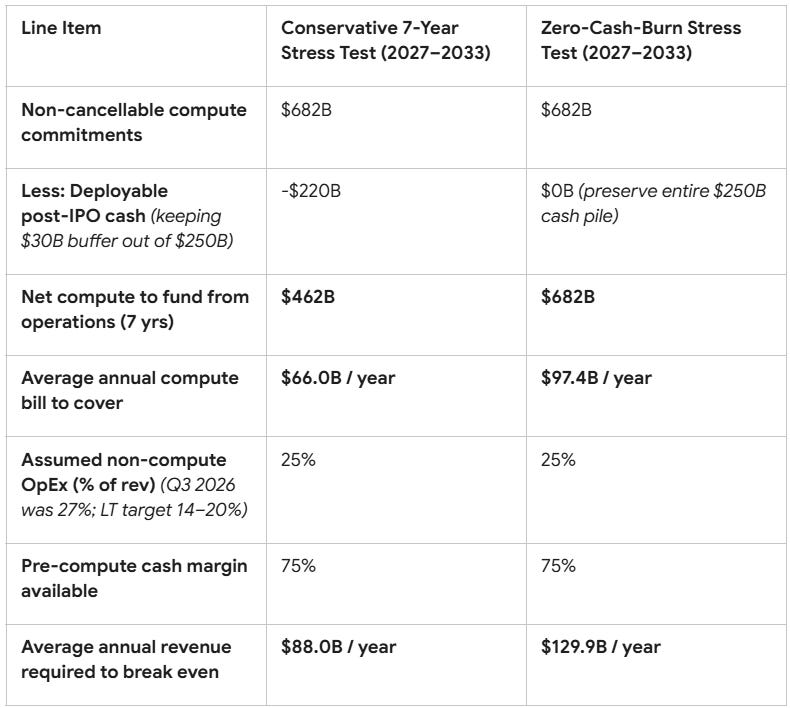
Let’s stress-test this conservatively. Suppose we assume all $682B of non-cancellable commitments have to be paid over the next 7 years (2027–2033)—which is harsher than reality, since Amazon runs to 2036 and facility leases run even longer.
Look at that bottom line.
Using its cash cushion: Anthropic only needs $88B in average annual revenue from 2027 through 2033 to pay off every single dollar of its non-cancellable compute commitments and still end 2033 with $30B in the bank.
Without touching a single dollar of its $250B cash pile: It needs $130B in average annual revenue.
Now compare that to where Anthropic already is today:
As of October 31, 2026, Anthropic’s run-rate revenue was already $81B (having just added $10B in a single month).
Lead underwriter Goldman Sachs models $136B in revenue in 2027 alone (and Dealroom’s base case has $136B in 2027 and $280B in 2028).
In other words, Anthropic’s revenue could literally stop growing next year and flatline for seven straight years, and it would still cover its entire non-cancellable compute stack without running out of money. And if demand ever slows in 2027, it cancels the $3.1B/month SpaceXAI contract on 90 days’ notice and watches its operating margin jump immediately. The bankruptcy narrative simply does not survive basic arithmetic.
Valuation
Finally, let’s analyze Anthropic’s valuation and see if it makes sense.