

Hey everyone,
I am posting an article on Anthropic Claude Code, which has been growing very significantly lately and, I believe, has developed an important product fit in its category.
Claude Code is going from just another AI coding assistant to a fundamental new architecture that developers need to stay competitive.
In the final months of 2025 and opening weeks of 2026, Claude Code reached a $1 billion annualized run rate just six months after launch—a velocity that even ChatGPT didn’t match. Based on my analysis and data, which I will share in this article, I believe that Claude Code is today closer to $2B ARR than $1B, as it has accelerated significantly in January.
At the same time, Anthropic’s overall annualized revenue jumped from approximately $1 billion at the start of 2025 to $5 billion by August—a 5x increase in eight months—with projections reaching $9 billion by year-end 2025.
But raw revenue growth, while impressive, misses the deeper structural shift. Claude Code has achieved what competitors couldn’t: it’s become the tool developers reach for when facing their hardest problems. At a Seattle meetup in mid-January 2026, over 150 engineers packed the house to trade use cases. One Google principal engineer publicly acknowledged that Claude reproduced a year of architectural work in one hour. Microsoft—which sells GitHub Copilot—has widely adopted Claude Code internally across major engineering teams, with even non-developers reportedly encouraged to use it.
Let’s dive in.
Anthropic is building a defensible moat in enterprise AI.
Anthropic reached 300,000+ business customers by August 2025, up from fewer than 1,000 businesses two years prior. According to Thunderbit, Claude’s enterprise AI assistant market share rose from 18% in 2024 to 29% in 2025—a 61% year-over-year increase—closing the gap with ChatGPT.
Anthropic just recently signed a term sheet for a $10 billion funding round at a $350 billion valuation—nearly double the $183 billion valuation from September 2025. That September round itself represented a massive step up from the $61.5 billion valuation in March 2025. The valuation has grown nearly six-fold in ten months—a trajectory that few technology companies have ever achieved, and the success is mostly tied to their developer clients.
Why are developers choosing Claude?
The market is littered with AI coding tools—GitHub Copilot, Cursor, Amazon CodeWhisperer, Tabnine, Codex, and dozens more. Yet Claude Code captured the developer community in ways its competitors haven’t.
The Architecture!
Claude Code’s distinguishing characteristic isn’t its AI model—though Claude 4’s coding capabilities are state-of-the-art. It’s the architectural decision to operate directly in the terminal with full file system and command-line access. This matters because it changes the fundamental relationship between developer and AI.
Traditional coding assistants like GitHub Copilot work as IDE extensions, offering autocomplete suggestions and chat interfaces. They’re stateless—every interaction starts fresh, with limited context beyond the current file. Claude Code operates differently. It reads and writes files directly, executes bash commands, maintains state across sessions, and coordinates multi-step processes spanning days.
As Noah Brier, an early LLM adopter who discussed the tool on Bloomberg’s Odd Lots podcast explained:
“ it’s more like hiring a junior developer than using autocomplete.”
The terminal-native design solves two problems that plague competing tools. First, it enables persistent state management. Claude Code stores information in files, building up context and knowledge over time. When working on a multi-day refactor, it remembers architectural decisions, maintains to-do lists, and tracks completed work—capabilities that chat-based assistants simply can’t match. Second, it leverages composable Unix commands. Instead of reinventing wheels, Claude Code chains together grep, sed, git, and other standard tools that developers already trust.
This architectural choice has profound implications for adoption. Developers don’t need to learn new interfaces or workflows. They work in the environment they already use—the terminal—with a tool that speaks their language. And because Claude Code operates as a true agent rather than an assistant, it can handle entire projects autonomously while developers focus on architecture and business logic.
The model advantage: Claude 4 and Sonnet 4.5
Ofcourse the underlying AI models matter enormously as well. Anthropic released Claude 4 (Opus and Sonnet) in May 2025, introducing what the company called “the world’s best coding model.” The benchmarks backed up the claim:
Claude Opus 4: 72.5% on SWE-bench (measuring ability to solve real GitHub issues), 43.2% on Terminal-bench (command-line tasks). Claude Sonnet 4: 72.7% on SWE-bench, balancing performance with cost-efficiency. Extended thinking with tool use: Models can now alternate between reasoning and tool use (like web search) during extended thinking sessions. Memory capabilities: When given file access, Claude 4 creates and maintains ‘memory files’ to store key information, dramatically improving performance on long-running agent tasks
Then in September 2025, Anthropic released Claude Sonnet 4.5, which became their most powerful model to date. The improvements were dramatic:
• 77.2% on SWE-bench Verified (82.0% with parallel compute)
• Code editing error rate: Dropped from 9% to 0% on Anthropic’s internal benchmarks
• Long-horizon task performance: Maintains focus for more than 30 hours on complex, multi-step tasks (vs. ~7 hours for Opus 4)
• 61.4% on OSWorld (desktop/browser interaction), up from 42.2% just four months prior
In November 2025, Anthropic released Claude Opus 4.5, which achieved 80.9% on SWE-bench Verified while using up to 65% fewer tokens than previous models. This efficiency translates directly to cost savings for developers running complex workflows.
Critically, these weren’t just benchmark improvements—they showed up in production. GitHub integrated Claude Sonnet 4 to power GitHub Copilot’s new coding agent. Cursor called Opus 4 “state-of-the-art for coding and a leap forward in complex codebase understanding.” Replit reported “dramatic advancements for complex changes across multiple files.” Block noted it was “the first model to boost code quality during editing and debugging.”
Bloomberry conducted research on over 45k companies, and the results are very insightful into which industries Anthropic dominates vs OpenAI.
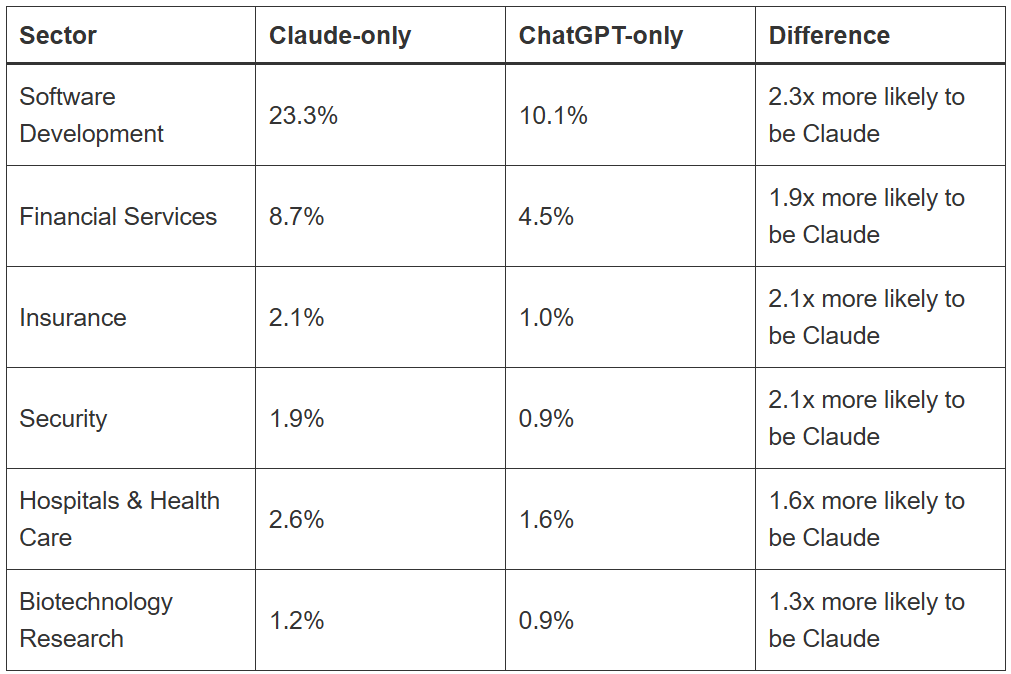
The software development vertical is especially interesting as companies are 2.3 times more likely to be Claude only than OpenAI only.
On the other hand, the industries where OpenAI dominates Anthropic are Marketing services, real estate, advertising, and business consulting.
In another developer survey conducted by UC San Diego and Cornell University in January, from 99 professional developers, Claude Code (58 respondents) appeared alongside GitHub Copilot (53) and Cursor (51) as one of the three most widely adopted platforms, with 29 respondents using multiple agents simultaneously.
In 2026, Claude is accelerating even faster with the launch of Cowork. The Cowork launch proved particularly significant. Users had been using Claude Code for non-coding tasks (vacation research, spreadsheet work via Slack, oven control). By launching Cowork, Anthropic showed that Claude Code’s total addressable market extends far beyond the 28 million professional developers globally.
Now, in addition to Cowork, we have a new trend of a personal assistant called Clawd bot. While Clawd bot is not owned by Anthropic but rather an open-source project, it has become the »ChatGPT« moment for personal intelligence, and for most users, Clawd works best when used with Claude, causing a surge in usage of Claude Code.
This is the most eye-opening chart from this article. This shows the daily install counts of AI Coding Assistants in Visual Studio Core. For those non-technical, VS Code is the industry standard for code editors and the primary host of AI coding agents:
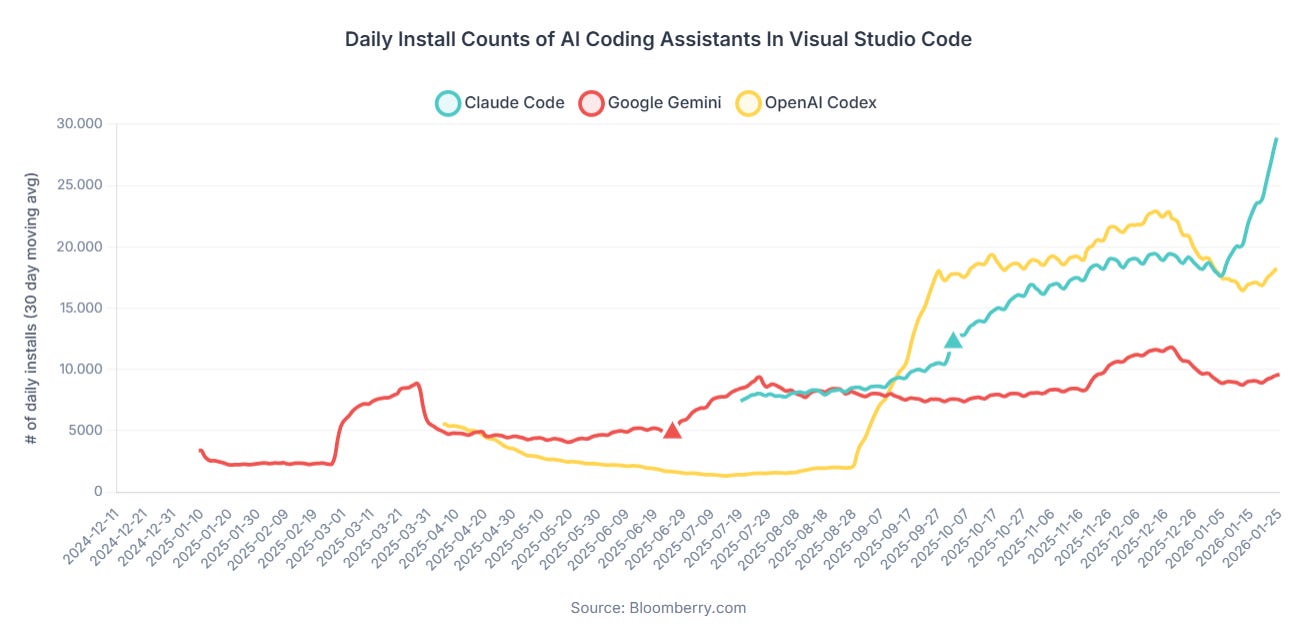
Since the start of 2026, Claude Code has been surging! It went from 17.7M of daily installs (30-day moving average), similar to where OpenAI’s Codex was, to 29M and continues to rise exponentially. This really shows that Claude Code is having its own »ChatGPT« moment TODAY.
Why does coding matter so much as an AI vertical?
In short, because the results are measurable, and companies can put serious investment behind these productivity gains. The academic research and enterprise case studies paint a consistent picture: AI coding tools deliver 26-55% productivity improvements, with experienced developers seeing the largest gains.
GitHub Copilot baseline: A 2022 controlled experiment found that developers using GitHub Copilot completed tasks 55.8% faster (95% confidence interval: 21-89%) than control groups. Subsequent enterprise deployments confirmed these gains:
• GitHub’s own research: Developers code up to 51% faster for certain tasks
• Accenture randomized trial: 8.69% increase in pull requests per developer, 11% increase in merge rates, 84% increase in successful builds
• Developer satisfaction: Up to 75% higher job satisfaction, 88% code retention rate (developers keep nearly all AI-generated suggestions)
• Success rates: 78% of developers complete tasks using Copilot vs. 70% without it, with 53.2% more likely to pass all unit tests
Claude Code’s reported gains exceed Copilot’s: Internal data from Anthropic and partner companies suggests even stronger performance for complex, long-horizon tasks:
• Developers report running 5-15 Claude Code instances concurrently—multiple in terminals, plus additional browser sessions
• Rakuten validated capabilities with a demanding open-source refactor running independently for 7 hours with sustained performance
• Boris Cherny (Head of Claude Code at Anthropic): “Claude Code generated roughly 80% of its own code” (with human direction, review, and architectural decisions)
A software engineer in the US costs $200,000-+$400,000 annually. If AI coding tools deliver even conservative 20-30% productivity gains, that translates to $40,000-$90,000 in annual value per developer. For a company with 1,000 engineers, we’re talking $40-90 million in annual productivity gains, justifying substantial spending on AI coding infrastructure.
Anthropic’s Business Momentum
The AI industry’s narrative has fixated on OpenAI’s consumer dominance—ChatGPT’s 800 million weekly active users, 2.5-3 billion daily prompts, and $500 billion valuation. But an important story for investors is playing out in enterprise adoption, where Anthropic is systematically outmaneuvering its larger rival.
This growth trajectory is unprecedented. For context, OpenAI’s 2025 revenue is estimated at $10-12 billion—larger in absolute terms but growing more slowly from a higher base. More critically, Anthropic is projected to break even by 2028, while OpenAI isn’t expected to turn a profit until 2030, according to November 2025 WSJ reporting. OpenAI faces approximately $74 billion in projected losses in 2028 due to massive compute costs, while Anthropic’s enterprise focus and efficiency gains position it for profitability much sooner.
While ChatGPT dominates consumer attention, Anthropic systematically captured the enterprise market where switching costs are high, and revenue is sticky.
According to Views4You, Claude has high penetration rates in different industries:
• Healthcare: 61% usage growth in early 2025, with Claude assisting in medical documentation and patient communication
• Legal: 18% of AI-enhanced litigation tools rely on Claude
• Finance: 24% of major banks use Claude, with 34% of enterprise AI research teams integrating it
• Retail/E-commerce: 38% of chatbots employ Claude
• Real Estate: 25% of listing analysis tools powered by Claude
This enterprise penetration is what separates Anthropic from consumer-focused competitors. Enterprise customers sign multi-year contracts, integrate deeply into workflows, and face high switching costs. Revenue from these customers is predictable, recurring, and premium-priced.
Anthropic with Claude Code is having its own ChatGPT moment, and it’s important, as coding is a big part of the economy and the job market, especially given the salaries. If there are 36M developers worldwide and their average salary is $48k per year, that would translate to $1.75T in developer salaries each year. If we only take the 20-30% production gains, we are talking about $350B to $525B of value created each year from these tools, and I would argue that the productivity gains are much higher than the 20-30%.
Anthropic’s TAM is bigger than many imagine, and its narrow focus on the enterprise and coding markets could prove to be a great strategy as things become more specialized, and it has built a strong head start and developer brand.
If you enjoyed this article, please consider subscribing to the paid subscription, where I share more in-depth analysis of AI companies and industry trends that I am seeing:
Until next time,
I hope you found this article valuable. I would appreciate it if you could share it with people you know who might find it interesting.
Thank you!
Disclaimer:
I own Google (GOOGL) & Amazon (AMZN), and Microsoft (MSFT) stock, which all have stakes in Anthropic.
Nothing contained in this website and newsletter should be understood as investment or financial advice. All investment strategies and investments involve the risk of loss. Past performance does not guarantee future results. Everything written and expressed in this newsletter is only the writer’s opinion and should not be considered investment advice. Before investing in anything, know your risk profile and if needed, consult a professional. Nothing on this site should ever be considered advice, research, or an invitation to buy or sell any securities.
Couldn't agree more. Your analysis of Claude Code's rapid ascent and strategic market fit is incredibly insightful. While the revenue growth is phenomenal, the deeper story, for me, lies in its capacity to tackle complex architectural challenges, fundamentally transforming how engineers approach their most difficult work.
Wow that's eye opener 👏 great work done