

Hey everyone,
Posting my regular quarterly channel check & alternative data report before we start the big tech Q3 earnings.
A quick look back first, because I think it is important to keep score. In my Q2 report, the expert interview data showed AWS as the standout in rate of change, with mentions of “best momentum” jumping from 27% to 42%. Based on that and my Anthropic math, I wrote that AWS could land in the 33-36% range (ex FX) vs. the Street at ~31%. AWS printed 36.7% YoY, its fifth straight quarter of acceleration and its fastest growth in 18 quarters. The signal was right; if anything, I was a bit too conservative on the magnitude.
This quarter, the same data is telling a somewhat different story.
In this report, I cover:
1. Cloud hyperscalers: what my expert interview momentum tracker shows for Q3
2. The AI orchestration layer: Microsoft vs. the LLM providers vs. Google and Amazon, and the AWS Bedrock vs. Microsoft Foundry race in job postings data
3. AI adoption signals: Copilot is accelerating, while Anthropic’s adoption data is starting to level off
4. Ad tech and Meta: what I expect for Meta and what worries me
5. My views heading into earnings for Microsoft, Amazon, Google, and Meta
Before we start with the article, I would like to announce that, together with a great alternative data provider team, we built and launched QAlpha AI. QAlpha AI is an alternative data platform with a focus on the Cloud, AI, and SaaS sectors. It extracts alternative data, including hiring data, adoption data from over 20k companies, infrastructure signals for more than 1700 products like new subdomains, DNS records, certificate transparency logs, and data center buildout data. We track all the big tech names Microsoft, Google, Amazon, Meta on top of hundreds of mid-sized and smaller companies in this sector. You can also track things like Claude, Codex, ChatGPT, Copilot, AWS Bedrock, and much more.
All the data crawled is public data, compliant, and does not bypass any CAPTCHA or circumvent authentication. The product is also priced very attractively compared to similar alternative data platforms, with what I believe is higher-quality and better-extracted data.
You will see me use much of the data from QAlpha in this article and in future ones, since it’s built to extract valuable insights for investors like me. Be sure to check it out; we also offer a 3-day free trial, and for the next few days since launch, we’ll offer a one-time 20% discount on the first year of usage.
Now let’s dive into the article.
Cloud hyperscalers
First, the backdrop, because it has not changed: cloud capacity is still sold out, and if anything, the sold-out window is getting longer.
On the All-In podcast last week, Ben Horowitz relayed a conversation with Andy Jassy that he had just a few days ago. Horowitz told Jassy he assumed the industry was out of capacity until 2028, and Jassy corrected him: »Oh, it’s beyond 2028. End of 2028, maybe.« A few days later, in Alex Kantrowitz’s interview with Sundar Pichai posted yesterday, Kantrowitz asked Sundar about the exact same comment. Sundar said that a customer »asking us for compute in ‘27, that is incredibly difficult to do«. He also admitted Google had to lease short-term compute last year just to accommodate some customers.
When supply is the constraint, cloud revenue growth is not a demand question anymore. It is a function of two things: how many megawatts each provider can bring online in the quarter, and what price they can charge for them and their existing fleet. On the second one, the data is clear. AWS raised reserved GPU pricing by 15% on October 7. That is the fourth consecutive quarter of price hikes and brings the cumulative increase this year to 40-75%.
Cloud compute is sold in roughly three ways: on-demand (pay by the hour, most expensive), spot (spare capacity at a discount that can be taken away), and reserved (you commit to 1-3 years in exchange for a lower rate). Reserved is the price large enterprises actually sign on. When reserved prices go up 15% in a single step, it tells you the provider has more buyers than it has capacity, and that is exactly the type of environment where margins expand.
The expert interview channel check
Now to my traditional expert call channel check. The results this time were quite surprising in some sense. I should note that the sample of high-quality expert interviews was smaller this quarter than in previous ones, so I would weigh the individual moves a bit less than usual.
In general, most experts noted a continued modest acceleration in demand for cloud services vs. previous quarters across the board. Nonetheless, the results become very interesting when we look at which platform had the best momentum:
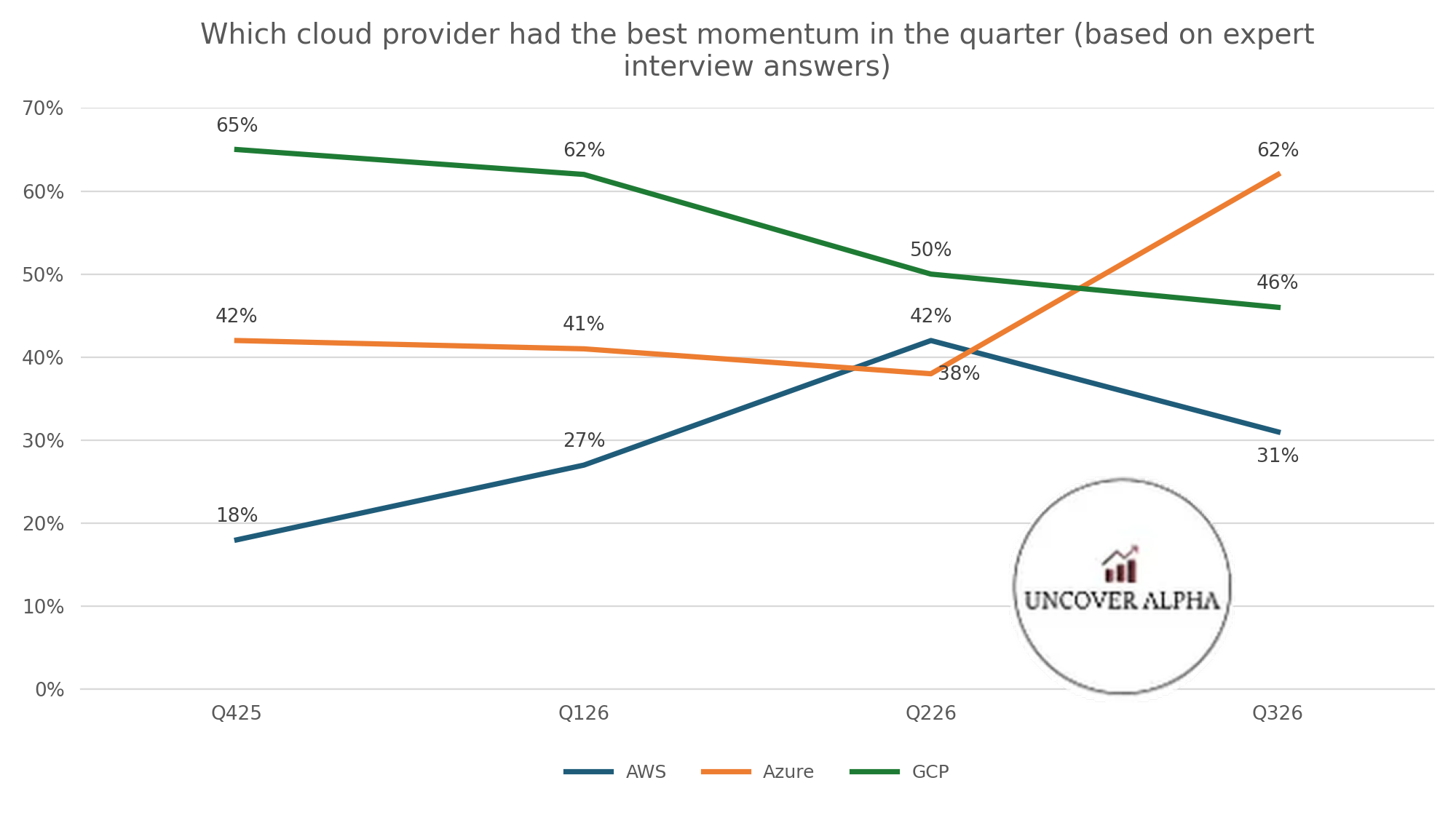
The standout is by far Microsoft Azure. Mentions of Azure as »growing the fastest« jumped from 38% last quarter to 62% now, a 24-percentage-point move in a single quarter and the biggest swing I have recorded in this series. As before, keep in mind that the numbers add up to more than 100% because many experts name two providers as fast-growing based on their observations.
On the other hand, AWS saw the most significant dip, going from 42% to 31%. GCP slipped from 50% to 46% and has now declined for three straight quarters (65% → 62% → 50% → 46%).
A few thoughts on how I read this:
• This is a rate-of-change signal, not a growth ranking. Last quarter, the AWS jump from 27% to 42% correctly flagged an acceleration, and AWS delivered 36.7%. This quarter, the Azure jump tells me the experts see the biggest incremental change at Microsoft. It does not tell me AWS is decelerating; as I expect AWS to also experience significant growth and acceleration, but the capacity might have gone to other places than the companies that these experts work for or consult for. At some point, maybe even this quarter, Microsoft will probably be the one who will have a rolling long-term contract with lower compute prices from the start of last year and get repriced soon, as they were the first to give and build significant capacity for OpenAI in the 2023 days. The question is whether they give that capacity to OpenAI or to other clients in the market with less negotiating power.
• GCP’s slow fade shoudn’t be read as anything to be honest as the changes are too small for it to be incremental in my view.
More on my concrete views from these readings and in general on Amazon, Microsoft and Google in the last section.
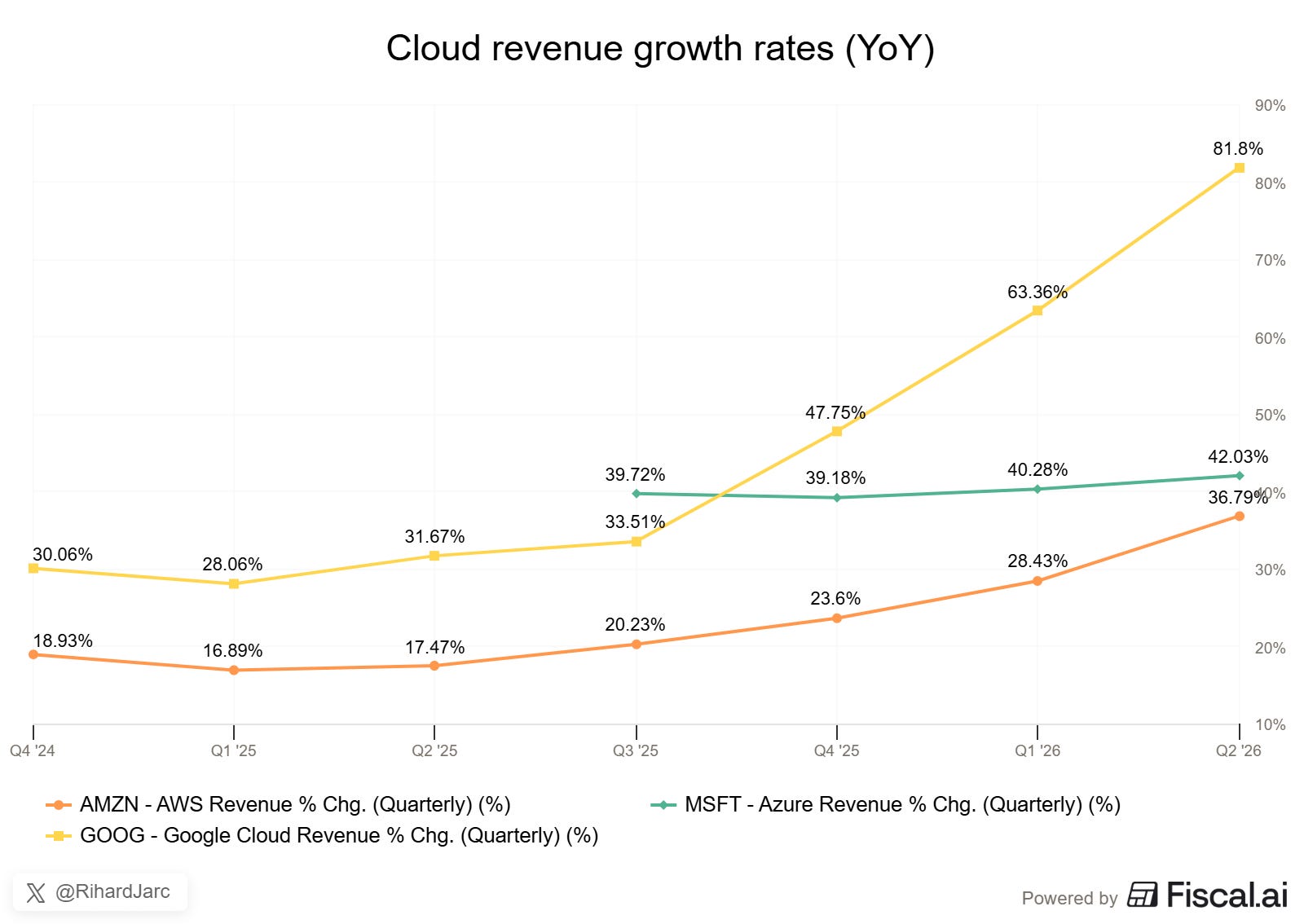
For context, here is where the three actually ended Q2. Note that Google Cloud’s 81.8% includes more than just GCP (Workspace and Gemini subscriptions are in there too):
What the Morgan Stanley CIO survey says about cloud share
The Morgan Stanley Q3 2026 AlphaWise CIO survey, published on October 12, had an interesting data point on current public cloud usage. Azure still dominates with 79% of respondents saying they use it, ahead of AWS at 66% and Google Cloud at 43%. But Azure has dipped slightly over the last two years, while both AWS and GCP gained this year in terms of % of respondents.
Another interesting part of the Morgan Stanley Q3 CIO survey was how fragmented the market has become in terms of who CIOs prefer for their AI orchestration layer. Microsoft is the only vendor with a higher % of answers (20%) than the LLM providers collectively (17%). Google got 5% and Amazon 4%.
The survey also asked which vendor will capture the biggest incremental share of GenAI spending:

It is important to note that these CIO’s are more inclined towards Microsoft products than the normal state of companies is; nonetheless, it is interesting to see how dominant Microsoft is in the view of being the orchestration layer vs. the other two cloud providers.
One more data point from the survey that I think is underappreciated: 42% of CIOs said they cannot yet measure the ROI on their AI token spend, 28% said returns are below what they spend, and only 13% are ahead. As a result, 43% already have token spend controls in place, and another 31% plan to have them by the end of 2027. That is roughly three out of four enterprises actively trying to control what they spend on tokens. In my view, this is a tailwind for the orchestration layer (routing cheap models to easy tasks is exactly what Foundry and Bedrock sell) and a headwind for the price per token at the model layer.
AWS Bedrock vs. Microsoft Foundry in job postings
It’s also interesting to look at company job postings to see how AWS Bedrock and Microsoft Foundry compete, as both are regarded as key AI orchestration layers. A company that writes “Bedrock experience required” into a job posting is telling you where it is building for the next few years.
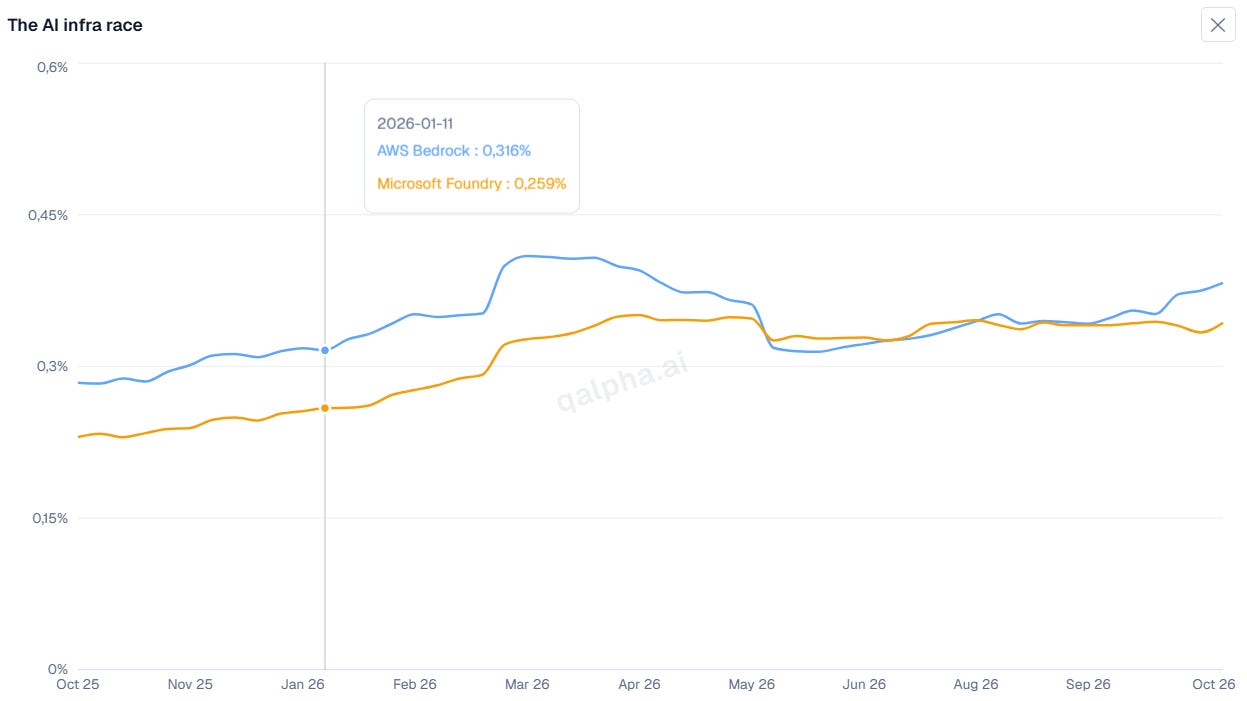
Bedrock was leading last year and up to May this year. In January, 0.316% of new job openings mentioned Bedrock vs. 0.259% for Foundry, a ~22% lead. Bedrock peaked at roughly 0.41% in March. In the summer months, Foundry searches were on par with Bedrock’s, at times even slightly higher, with both in the ~0.33-0.35% range. Now, in October, Bedrock has again taken the lead at roughly 0.38% vs. ~0.34% for Foundry.
The takeaway for me: this is a two-horse race that is much closer than it was a year ago. Also note that new frontier models now launch on all three platforms on day one. Claude Fable 5.1, for example, was available on Bedrock, Google Cloud, and Foundry the same day it launched on September 1. The model is no longer the differentiator for the platform; the harness, the integrations, and the existing customer base are.
AI adoption signals: Copilot accelerates, Anthropic levels off
Copilot is pulling away
Microsoft Copilot has been leading the “assistant race” in job postings ever since mid-last year, but in the last 90 days, it has accelerated the most of any provider (the blue line below).
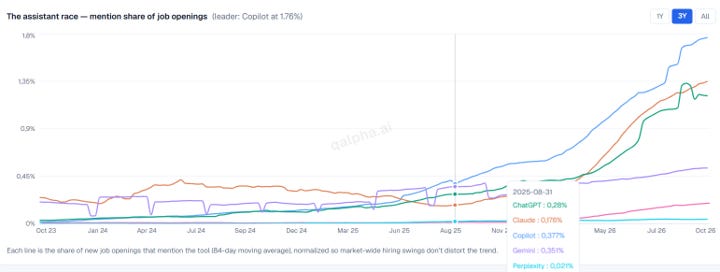
Some numbers to put this in perspective:
• Copilot is now mentioned in 1.76% of all new job openings monitored by QAlpha. At the end of August 2025, it was 0.377%. That is a ~4.7x increase in about 14 months.
• Over the last 90 days, Copilot went from roughly 1.3% to 1.76%, a ~0.45-percentage-point gain. Claude added roughly 0.1-0.15 points over the same period (to ~1.33%), while ChatGPT spiked and then fell back to ~1.2%.
• Gemini sits at roughly 0.5%, up from 0.351% in August 2025. That is only ~1.4x in 14 months, by far the slowest growth among the major assistants.
This lines up with what Microsoft told us on the Q2 call: 30M+ paid Microsoft 365 Copilot seats, net seat adds more than doubling QoQ, and Copilot revenue up over 60% QoQ. When companies start writing a tool into their job descriptions, it means the tool has moved from a pilot to a workflow.
But the important takeaway from this data for me was that in the last 90 days Copilot was the fastest grower even compared to OpenAI Codex or Claude, which is not something I think the market believes, so the Copilot numbers for Q3 might surprise people.
Microsoft is hiring again
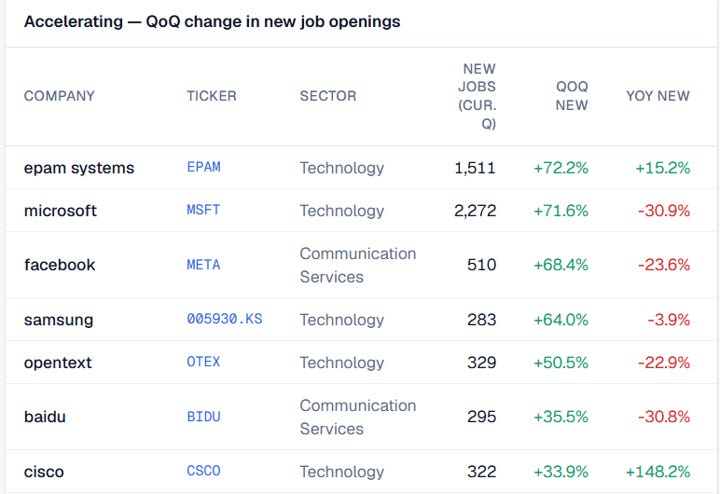
Microsoft has also significantly accelerated hiring this quarter, with new job openings up 71.6% QoQ to 2,272. That is still 30.9% below last year’s level, so this is a rebound from a low base rather than a hiring spree, but the direction is clear. Also, looking at the roles of these hires, there is a visible uptick in sales roles, which might suggest Microsoft has finally found the product-market fit with Copilot and wants to market it aggressively now. Interestingly, Meta shows a similar pattern (+68.4% QoQ, -23.6% YoY).
Anthropic is starting to level off
On the other side, Anthropic is starting to level off when looking at how many job postings mention it.
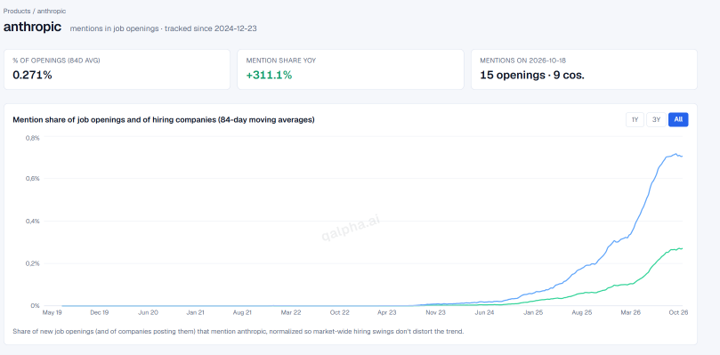
Anthropic is now mentioned in 0.271% of new job openings (84-day average), up 311.1% YoY. So the absolute level is still growing strongly on a yearly basis. But the share of hiring companies that mention Anthropic (the blue line) has flattened at roughly 0.7% since late summer, after going nearly vertical from March to August.
A similar trend is seen when looking at the adoption signals that QAlpha measures, which count net new companies adopting each tool per month (adoptions minus churns):
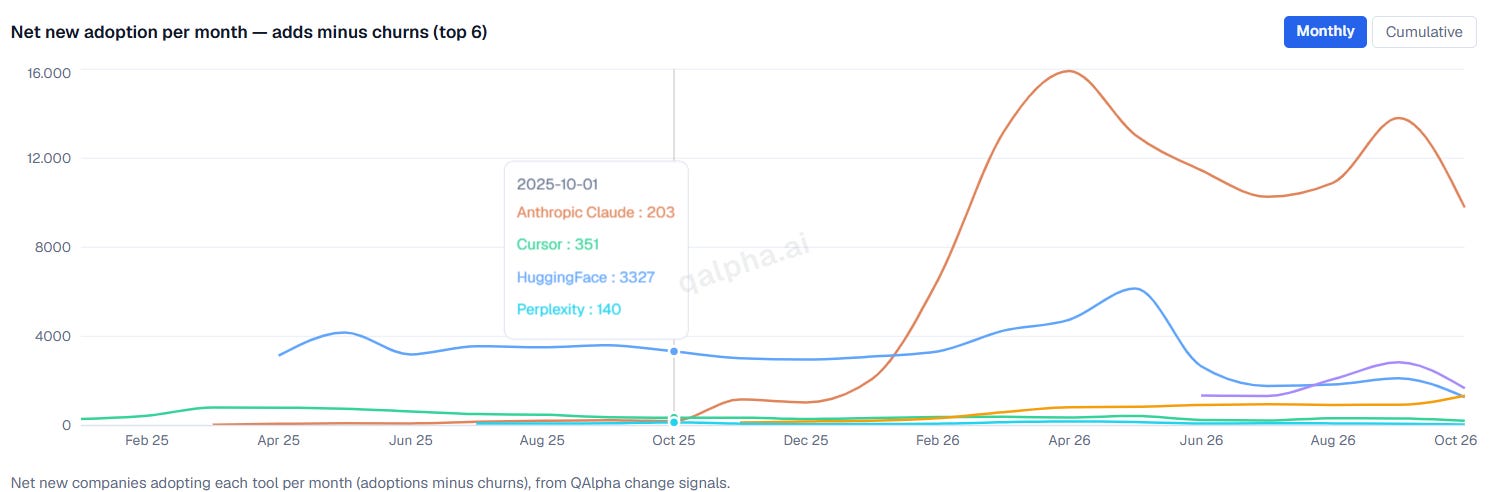
To put the scale in context: in October 2025, out of the companies that QAlpha tracks Claude added a net 203 companies in a month. By April 2026, that was roughly 16,000 per month. Based on this data, Anthropic’s Claude adoption peaked in April this year. It then fell to roughly 10,000 net adds in July. Part of that trough likely overlaps with the June 12 to July 1 suspension of Fable 5 and Mythos 5 access due to the U.S. export controls, although the decline had already started in May. It regained ground in September (roughly 13,800 net adds), as both Fable 5.1 (September 1) and Opus 5.5 (later in September) launched, but it is now trending down again, to roughly 9,800 in October.
That down pattern is consistent with other services that QAlpha tracks, such as ChatGPT and HuggingFace. HuggingFace, for example, peaked at roughly 6,100 net adds in May and is now at around 1,300.
How I read this: it does not mean Anthropic’s business is shrinking. Net adds of ~10,000 companies a month are still enormous, and existing customers are likely consuming far more tokens per company. What it does suggest is that the land-grab phase of enterprise AI adoption is maturing, at least for the vertical of coding. The companies that were going to try Claude have largely tried it. Growth from here depends more on expansion within existing accounts and going after new verticals, which is exactly where the orchestration layer, seat-based products like Copilot, and cost controls start to matter. It is also a data point to keep in mind for anyone looking at the upcoming Anthropic and OpenAI IPOs.
Ad tech and Meta
In terms of the ad sector, my channel checks point to