

Hi everyone,
On September 8, Meta launched Muse, a personal AI agent that sends your emails, books your travel, fills out your forms, buys things for you, and lowers your bills. Thirteen days later, it had 2.5 million downloads in North America and was number 1 in terms of downloads on both the App Store and Google Play ever since. A few days ago, we also got a revamp of an AI agent from Microsoft named Autopilot, and yesterday we got OpenAI’s agent called Dots and we also have the agent startup Instinct.
The takeoff of personal and work AI agents does significantly shift some market dynamics in different sectors of the economy, and in this article I will try to explain those effects and for which sets of companies the changes might be disruptive in nature.
Topics I cover:
1. Explain how these agents actually work under the hood and why that matters for who captures value.
2. Break down where aggregators actually make their money today and why they might be in danger of serious negative change to their business models
3. What parts of the economy might get a positive boost as friction of doing things drops
4. At the end, share my analysis of 34 public companies that I think are most exposed to this trend and quantify that negative effect
Before we start with the article, I would like to invite you to watch my recent conversation with Andy Hock (Cerebras Head of Strategy), Chris Ackerson (SVP at AlphaSense) and Kyle Cheng (Former Anthropic employee) on the role of the harness, token optimization techniques, importance of fast tokens and other trends in this space. It was a really insightful discussion!
Now let’s start with the article
How a personal AI agent actually “does” things
Before we get to the companies, it is worth spending a few minutes on the plumbing, because the way an agent touches a website decides who keeps the economics. There are basically three ways an agent can act on your behalf, and they have very different implications for aggregators.
1. The agent uses the website like you do (computer-use / browser agents). The model gets a virtual computer, looks at screenshots of the page, and clicks, scrolls and types like a human would. Perplexity’s Comet works like this, and so does Muse, which runs each user’s agent on its own cloud virtual machine with a second “Sentinel” agent approving anything that leaves it. The upside: it works on any website, with no permission needed from the site. The downside: it is slower and more error-prone. Amazon is literally building “digital gyms” where its Nova Act agents practice scrolling, clicking and interacting with interfaces because this is still hard.
This is the route aggregators cannot easily block. On August 4, 2026, the Ninth Circuit vacated the injunction Amazon had won against Perplexity, holding that Amazon was unlikely to win its computer-fraud (CFAA) claims. The court’s logic was simple: because the agent acts at the user’s direction, it is the user, not Perplexity, who is accessing Amazon’s servers. Amazon can still enforce its terms of service through contract claims, and the case is not over. But the cheapest legal weapon an incumbent had against agents, “you are hacking us,” got a lot weaker.
2. The agent calls the service’s own tools (APIs, MCP, “apps”). Instead of clicking around a page, the agent talks to the business directly through a structured connection. Model Context Protocol (MCP) is the open standard most people now use to plug AI apps into outside systems. OpenAI’s apps inside ChatGPT, launched in October 2025 with Booking.com and Expedia among the first partners, work this way. This route is faster and more reliable, but the business decides what it exposes, and at what price. Think of it as the aggregator opening a drive-through window: the agent never walks into the store, so it never sees the candy at the checkout.
3. The agent uses a shared commerce protocol. This is the newest layer. Rather than every agent integrating with every merchant one by one, a common “language” handles the catalog, the cart, and the payment:
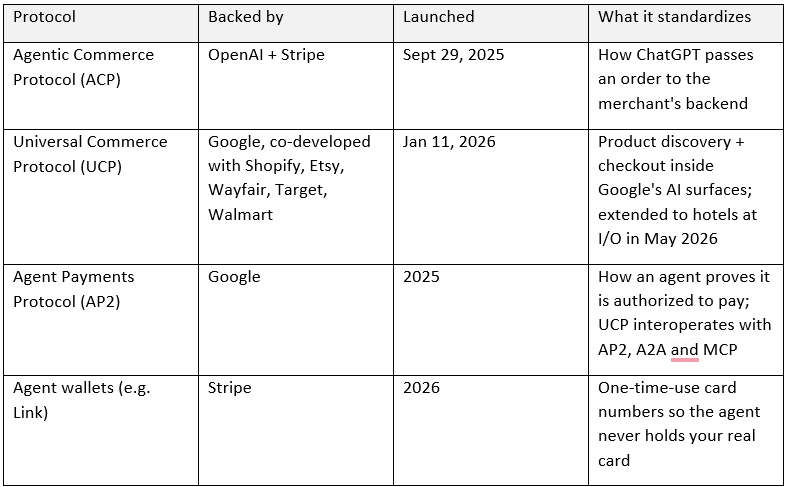
The important design choice common to all of these: the merchant stays the merchant of record, but the agent owns the conversation. Google’s hotel booking in AI Mode is a good example. It launched in August with Booking.com, Expedia, Hilton, Marriott, IHG, Choice, Wyndham, Priceline, Hotels.com, and Trip.com, and Google passes partners only the minimum needed to complete the booking (name, payment, occupancy, property). The inspiration, the comparison, the “why this hotel and not that one” all stay with Google. On top of that, Google says there are no paid placements and no way for partners to commercially influence ranking, at least for now.
But in essence the agent keeps the demand signal, and the aggregator gets reduced to a fulfillment API.
I want to be fair here, the first attempt at in-chat shopping flopped. OpenAI launched Instant Checkout in September 2025 promising “over a million” Shopify merchants, and by February 2026 only about 30 Shopify merchants were live. In March, OpenAI moved checkout into merchant apps instead. Booking’s CFO said on the Q2 call that LLM referral traffic is still under 1% of room nights and has not moved much. So if you are looking for this in the P&L today, you mostly will not find it.
But the thing that failed was the chatbot with a buy button, a model where the user still had to do the comparing and the clicking. Muse, Dots, Instinct, Google’s AI Mode booking, and Comet are something different: the agent does the comparing, remembers your preferences, and completes the task while you are doing something else. My view is that the chatbot-with-a-checkout era was the Palm Pilot, not the iPhone.
Instinct’s CEO shared some very interesting data points on the recent Invest Like the Best Podcast. He said that after 3 weeks, 40% of the user base shares the credit card with the Instinct AI agent. He also said data showed that if you share one piece of sensitive information with Instinct, retention is 80% (which is very high for a consumer product). He also explained that $1B of transaction value already flows through Instinct, and 50% of that was travel use cases.
So from this early data (as Instinct was soft launched in August), we can see early signs the market is ready for personal AI agents and users are ready to shift use cases such as travel bookings and shopping to these agents.
Where aggregators actually make their money (and which part an agent eats first)
Quick refresher on aggregation theory. An aggregator wins by owning the relationship with the end user, so that suppliers (hotels, restaurants, drivers, sellers) have to come to it. Once it owns demand, it can monetize in a few different ways. The reason I think most analysts are underestimating the agent risk is that they treat an aggregator’s revenue as one number. It is not. It is a stack of very different revenue types, and an agent attacks each one with a different force.
Here is how I break it down:
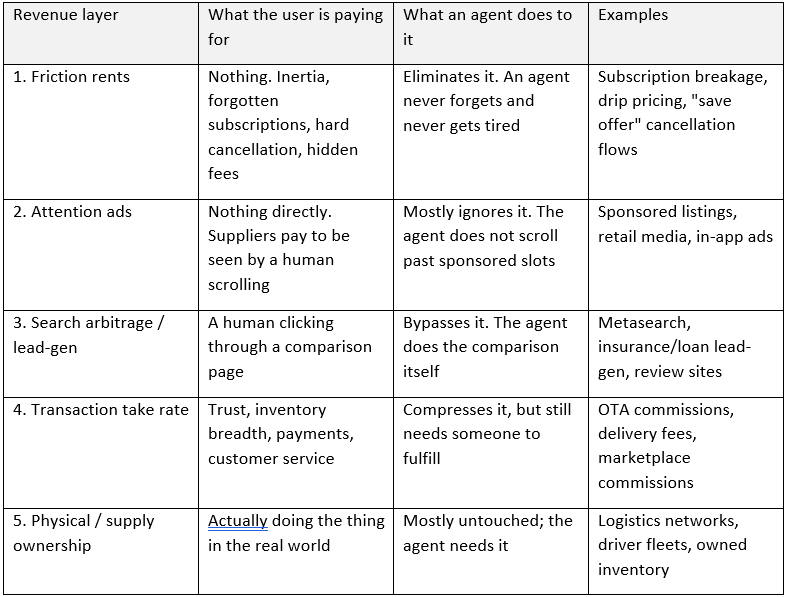
The higher up the table a company’s profit pool sits, the more dangerous agents are to it. Let me put some numbers on layers 2 and 3, because they are bigger than most people think.
Attention ads are now a core profit engine for aggregators. Over the last three years, almost every marketplace has quietly built an ad business on top of its human traffic, and those ads are close to 100% gross margin:
DoorDash, Uber Eats and Instacart together now generate more than $4 billion in annualized advertising revenue. Uber Advertising alone passed a $2 billion run rate, with delivery ad penetration above 2% of gross bookings. On $58.0 billion of quarterly gross bookings, that is a meaningful slice of Uber’s profit.
Instacart’s advertising and other revenue was $958 million in 2024, roughly 30% of its total revenue, and $286 million in Q1 2026 alone.
Amazon’s ad revenue was $68.6 billion in 2025, and roughly $60 billion of that is on-site search ads, i.e. sponsored products shown to a human typing into the Amazon search box.
Now think about how an agent chooses. OpenAI’s own description of ChatGPT shopping says it ranks merchants on availability, price, quality and whether the merchant is the primary seller. There is no line item for “who paid for the slot.” Google says the same for hotels in AI Mode. When the buyer is a piece of software optimizing for your stated preferences, the ad becomes irrelevant. Every dollar of in-app ad revenue is, in effect, a bet that a human will keep looking at the app.
Layer 3 is already breaking, and we have a live case study. If you want to see what happens to an aggregator whose value is “we help the human compare,” look at Tripadvisor. In Q2 2026, its Hotels segment (the old metasearch business) saw revenue down 23% to $117.9 million, with media and advertising down 12%. Management is guiding the whole Hotels & Other segment to decline another 20% to 23% in Q3, citing structural changes in its main SEO channel. And this is from Google’s AI Overviews, which are merely summarizing the comparison for a human. Agents that act on the comparison are the next step and make this even worse.
Even the strongest aggregator is paying more to stand still. Booking Holdings is, in my view, one of the best-run OTAs in the world, and even there you can see the cost of the transition. Booking’s marketing expense was 4.7% of gross bookings in Q2 2026 vs 4.6% a year earlier, and marketing grew 11% while gross bookings grew 9%. The company’s own 10-Q says it expects SEO traffic to decline in the short to medium term, which may push more spend into paid channels. That is the first-order effect: free traffic becomes paid traffic. The second-order effect, when agents do the booking, is that the paid traffic goes to a new toll collector.
So the question for every company in this article is really simple: how much of your profit comes from layers 1 to 3, and how much from layers 4 and 5?
The friction economy: an agent has infinite patience
A large part of the consumer internet does not make money from delivering value. It makes money from the gap between what a customer would choose if they were paying full attention and what they actually do on a Tuesday evening when they are tired. The industry has names for this: breakage, passive retention, save offers, default enrollment.
When analyzing this segment, I found out that the gap is bigger than people realize, and consumers themselves have no idea:
• When C+R Research asked consumers to estimate their monthly subscription spend, the average guess was $86. When they itemized it line by line, it was $219 a month, a $133 gap.
• A West Monroe survey of 2,500 U.S. consumers found 89% underestimated their monthly subscription spend, and 66% were off by more than $200 a month.
• Self Financial’s 2026 survey found 59.9% of people have at least one paid subscription they did not use in the last 30 days, averaging 2.6 idle subscriptions each.
That unused-but-paid revenue is close to pure profit for the company collecting it. No servers, no content cost, no support tickets. Every investor who has modeled a subscription business knows that the quiet cohort, people who stopped using the product but did not bother to cancel, carries a disproportionate share of margin.
We have a lot of these cases just looking at legal data from the last 2 years:
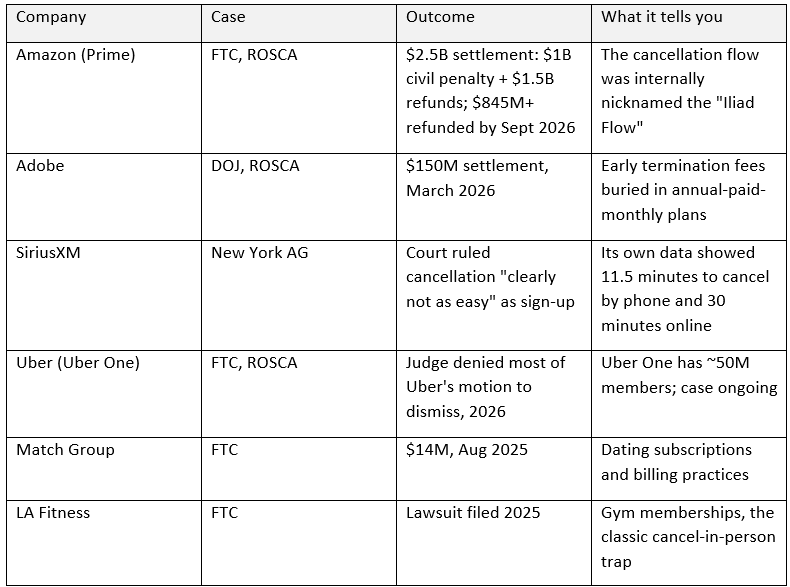
Meanwhile, the rule that was supposed to fix this systemically is dead, for now. The FTC’s “click-to-cancel” rule was vacated by the Eighth Circuit on July 8, 2025, days before its main compliance deadline, on procedural grounds. The FTC restarted rulemaking on January 30, 2026, but a new rule is probably years away.
Many companies breathed a sigh of relief in July 2025 when click-to-cancel was struck down. They thought the friction moat survived. It seems now that it survived regulation only to be killed by technology.
The entire design of a cancellation maze assumes a human on the other end: someone who gives up after the third “are you sure?” screen, who does not want to wait minutes on hold, who accepts the save offer because it is 9 pm. An agent has none of these weaknesses. It does not get bored. It will sit through a six-part retention script, decline every offer, screenshot the confirmation, and put a reminder in your calendar to check the next statement. And it will do it for all of your idle subscriptions at once.
Meta literally advertises Muse as an agent that can lower your bills. It is worth noticing that Meta even tested a “human concierge” function where contract workers would handle some of the phone calls Muse places for users, because human involvement in calls produced higher success rates. That feature was halted over privacy concerns, but think about what it tells you about the use case: phone-only cancellation and bill negotiation are exactly the jobs being targeted.
The second-order effect is even more important for valuation. When the cost of cancelling goes to zero, the cost of switching also goes to zero. An agent that audits your subscriptions every month will also tell you, for example, that the same car insurance policy is a few hundred dollars cheaper elsewhere, or that your streaming bundle overlaps. The business models that get hurt here are not just the ones with bad cancellation flows. They are the ones whose retention curve is propped up by inattention rather than by product value.
And it’s not just subscription businesses; many businesses could see significant changes if personal AI agents go mainstream and constantly compare prices for goods and services that don’t have a significant differentiating factor: banks, insurance companies, airlines, etc.
The traffic was already moving towards this even before we got mainstream AI agents; this will only accelerate it
Adobe Analytics, which tracks over 1 trillion visits to U.S. retail sites, shows AI-referred traffic to retailers grew 138% YoY in May 2026 and 1,324% since October 2024, converting 54% better than non-AI traffic. In travel, AI traffic grew 194% YoY. Travel conversion from AI still trails non-AI traffic by 28%, but that gap is nearly 70% smaller than in October 2024. Consumers are still clicking through to finish the booking themselves, but they are doing less and less of the choosing on the aggregator’s site. AI agents will speed this up.
The forecasts are big, but I would not anchor on them. McKinsey sees $900 billion to $1 trillion of U.S. retail revenue from agentic commerce by 2030 and $3–5 trillion globally. Morgan Stanley’s AlphaWise work has agents capturing 10–20% of e-commerce, or $190–385 billion. I think the exact number matters less than the direction.
One more thing worth noting about who is building these agents: every serious contender (Google, Meta, OpenAI, Amazon) is either an ad company or a company that wants to become one. Their incentive is to capture the toll themselves, not to eliminate tolls. This matters for the ratings below: the risk to an aggregator is rarely that its take rate goes to zero. It is that a new, bigger aggregator starts taking a slice before it.
How the aggregators are fighting back: wall, plug in, or become the agent
The incumbents are not sitting still, and their responses sort into four playbooks.
Playbook 1: Build a wall. Amazon is the clearest example. It sued Perplexity, blocked 47 AI bots from crawling its site, and on September 21 blocked Muse. The logic is obvious: roughly $60 billion of Amazon’s ad revenue depends on humans typing into the Amazon search bar. The problem is that the wall got a lot shorter on August 4. With the Ninth Circuit saying a user-directed agent is the user, Amazon is left mostly with terms-of-service enforcement and technical cat-and-mouse. Walls work when you are the destination customers cannot do without. They can backfire when they just make you invisible to the fastest-growing demand channel.
Playbook 2: Plug in everywhere and become the fulfillment API. This is what most of the travel and delivery names are doing:
Expedia is in ChatGPT apps, is a Google AI Mode launch partner and was the first OTA inside Muse, where it remains merchant of record.
Booking is a Google AI Mode launch partner and, per its CFO, is part of OpenAI’s test group for cost-per-click ads.
Instacart is everywhere: Google’s first grocery partner on Gemini, ChatGPT, Claude, and as of last week a connector inside Muse. It also licenses its Cart Assistant to retailers.
DoorDash and Uber Eats joined ChatGPT apps but redirect users to their own apps for checkout. That is a half-in, half-out strategy: be discoverable, but keep the final screen where the ads and the upsell live.
There is a case to be made that agents like Muse, which do not take a commission today, could even be a source of free traffic. On that tho, I would remind you what Zuckerberg said about the business model. “Free” is the customer acquisition phase. The toll comes later, and it will be priced against what the aggregator used to pay Google, and Zuck already said that the way they see in monetizing this business is via a transaction take rate.
Playbook 3: Become the agent. Amazon has Rufus (used by 300 million+ customers in 2025, with a 60% higher purchase completion rate) and Buy for Me, which flips the script by shopping other retailers from inside Amazon. Booking has Priceline’s Penny. Instacart has Clementine. The problem, as I see it, is that vertical agents are exactly what a general personal assistant makes redundant. Nobody wants a travel agent, a grocery agent, and a restaurant agent. They want one assistant that knows their calendar, their budget, and their partner’s allergies. Vertical agents are good for conversion inside the app. They don't solve the "who owns the first question" problem.
Playbook 4: Fortify the part an agent cannot replace. This is the one I like most. It means doubling down on the things that sit in layers 4 and 5 of my framework: owned supply, loyalty economics, payments, logistics, customer service when things go wrong. Booking’s Genius Level 2 and 3 members already account for a high-50s percentage of Booking.com’s trailing room nights. An agent optimizing for best price will pick Booking if the Genius discount makes it cheapest. That moat survives the agent, but it pressures margins, so economies of scale matter even more.
The other side of the coin: zero friction can grow the pie
So far I have focused on what agents take away. But friction does not only protect bad revenue. It also kills good revenue, every single day, and that is the part of the story.
Friction destroys a lot of demand. The average documented e-commerce cart abandonment rate is 70.22% across 50 studies, and Baymard estimates around $260 billion of lost orders in the U.S. and EU are recoverable through better checkout alone. The top reason, at 48%, is unexpected extra costs, which is exactly the kind of surprise an agent that quotes the all-in price up front eliminates. Put simply: seven out of ten people who already wanted the product did not buy it.
When friction drops, conversion jumps. AI-referred traffic to U.S. retailers already converts 54% better than non-AI traffic. Amazon says Rufus users complete purchases at a 60% higher rate. These are early, assisted versions. A fully agentic flow removes the last steps too: the form, the login, the card number.
Agents turn intent that used to die into orders. Muse can turn a recipe reel you saved into a grocery list. Before, that reel died at the “I’ll do it later” moment. Now it becomes an Instacart basket. The same logic applies to the trip we never booked because planning flights, hotel, and activities took a lot of time and effort. Booking’s connected trips, where one customer books several travel verticals together, are already a low double-digit share of Booking.com transactions and growing faster than the core. Agents make the multi-step trip a one-sentence request.
Where I expect the biggest volume uplift:
• Planning-heavy purchases: travel, experiences and events, where the pain is coordination, not price. Viator bookings are already growing 10%.
• Frequent small orders: grocery top-ups, food delivery reorders, rides. When “order the usual” is one sentence, frequency goes up.
• Local services people postpone: the plumber, the dentist, the car service. The job was always needed; getting quotes was the barrier.
• Long-tail goods: agents do not stop at page one. Etsy already gets over 20% of its referral traffic from ChatGPT.
Where it will not help much: need-driven, infrequent purchases like housing, cars and insurance. Nobody buys a second house because the search got easier. That distinction matters a lot for the re-rating further down.
Agents are bad for the part of a company’s revenue that comes from human attention and friction. They can be good for the part that comes from actually delivering the service, if the company is the one doing the delivering. The winners will be businesses where the underlying product has elastic demand and where the company is the fulfiller the agent routes to.
The danger list: 34 public companies rated 1 to 5
I rated each company on how much of its profit depends on layers 1 to 3 of my framework (friction, attention, comparison) versus layers 4 and 5 (fulfillment and physical supply). 5 = most at risk, 1 = least at risk. The horizon is 3–5 years, not next quarter.
How I score it. A single 1–5 number hides a lot, so behind every rating sit four drivers. I did not average them mechanically, because they do not matter equally for every business, but they explain almost every rating:
1. Ads & friction exposure: how much profit comes from sponsored placement, fees a human does not notice, or subscriptions a human forgets to cancel. High = bad.
2. Comparison dependence: is the product itself “helping a human compare”?
3. Supply moat: does the company own or control something physical or exclusive that an agent has to route to (drivers, warehouses, unique listings, loyalty funded by suppliers)?
4. What share of each company’s profit comes from human attention and friction, and what happens to the rest if agents make buying the underlying service effortless?
The results might be surprising to some, as for some it is not what the market is currently thinking. Here are the results: